
What is anxiety and how do I know if I have it?
I lived with anxiety for over 20 years. It started as social anxiety mostly only large crowds and it grew to panic disorder and severe agoraphobia over time. I tried a multitude of medications. I got really good at knowing my triggers to the point it seemed OTHER PEOPLE were my triggers. At 40, I had at that time been steadily medicated about ten years I took a look at my life and realized while I was actually what you would call “mentally stable” for several years when I honestly looked inside myself - I felt dead inside. On paper, my life looked fine. Steady relationship that had been my healthiest to that point, a business that I built from an idea that suddenly was falling flat?
What did that mean? It means I suddenly wasn’t interested in the life I had spent the last seven years building. I ignored this feeling and kept going to work and then out of nowhere, massive anxiety? I had struggled with it my entire life however it was typically only an issue at this point in unfamiliar or social situations. When I was running and leading the event, for example, I was totally fine. This was no longer the case. I found myself reaching for xanax after years of not needing it and for the first time I didn’t run to the doctor. I retreated within myself.
This was likely the best decision of my life, and a major turning point. I had to understand, WHY this was happening. Where was this anxiety coming from? If anxiety is just an emotion felt in the body after the brain is worrying about the past or future then why was it striking suddenly and randomly? It was intuition in survival mode - simply a signal from my soul “I want something new.” I ignored the loss of motivation and ambition - they were the first signals. I kept pushing through because that’s what we do and what happened? The Universe took my business anyway by creating a disaster with a roof leak and management company. I had to close the doors. I ignored the signs that it was time for something new, so it was taken.
What I have come to understand firstly about anxiety is that when your nervous system is stuck in survival mode, intuition can also FEEL like anxiety. They are not the same thing, but they have a similar sensation in the body. Same with FEAR and EXCITEMENT they feel the same - yet they are different.
The problem with many of us “sensitive” folk is we unknowingly are absorbing these same sensations from people in our environment - this to me felt like a constant cloud of anxiety, nausea, agitation, general unwell. If you have this as your baseline energy - this may be your explanation as well. When you learn to discard energy that isn’t yours, you aren’t weighed down, feeling sick. It’s called energy protection, a form of energy hygiene which means to cultivate, care for, and maintain your own personal energetic and emotional state.
When you learn to cleanse your energy, stop leaking energy, and most importantly, STOP absorbing your environment you will find that daily underlying anxiety - GONE.
Sometimes it’s not anxiety. Sometimes it’s intuition, sometimes its excitement and fear mixed together and sometimes it’s NOT EVEN YOURS. Click here for my energy protection for sensitives class. Scholarship is available to those that income is a barrier. Please click here to send us an email to inquire.
Why Workplace Wellness Needs More Practice and Less Talking
We talk a lot about workplace stress and burnout. But knowing you're stressed doesn't necessarily give you the ability to change how you feel in the moment.
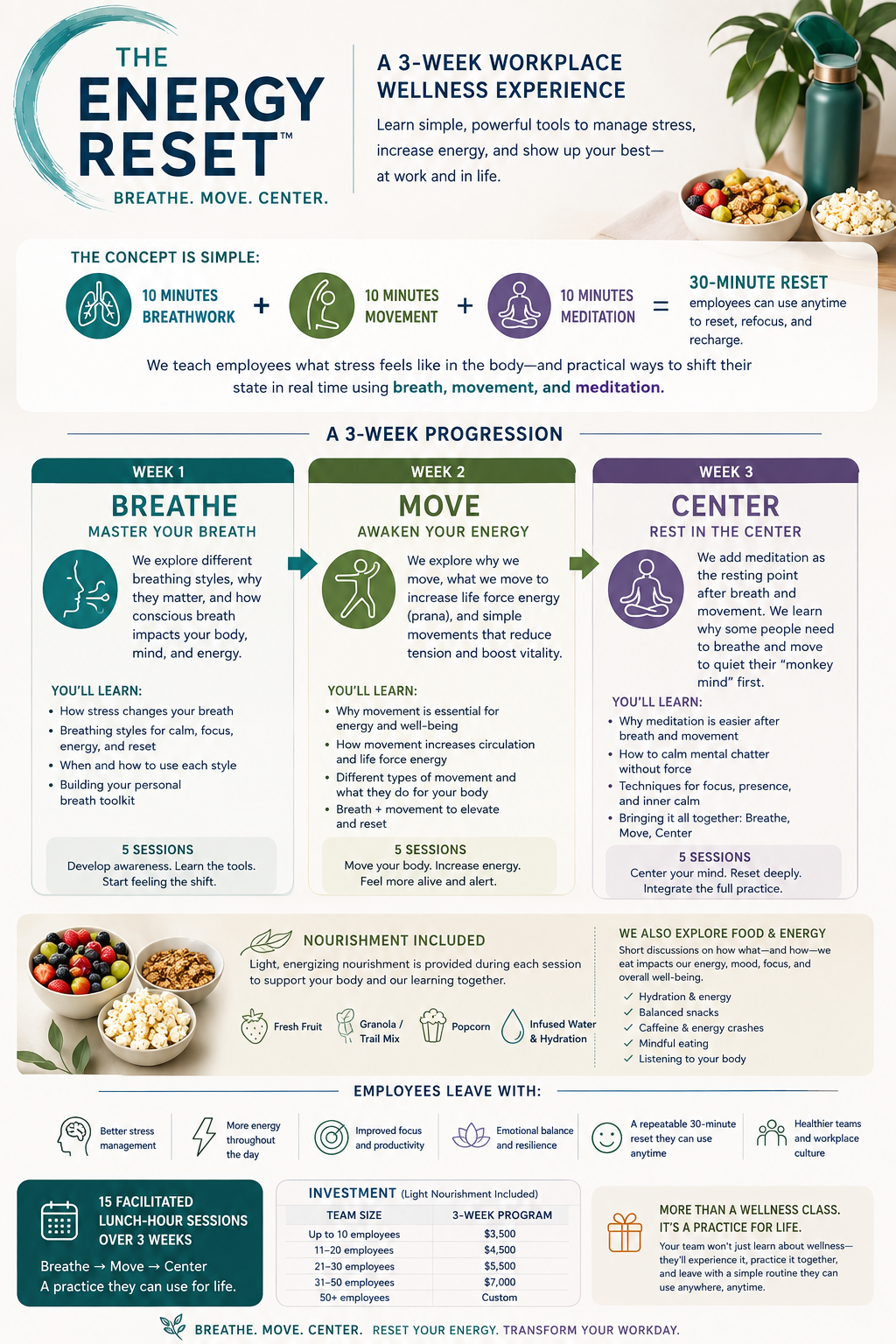
That's why I created The Energy Reset™, a three-week workplace wellness experience built around one simple progression:
Breathe. Move. Center.
Instead of beginning with meditation and asking an already-busy mind to suddenly become quiet, we start with the body.
Week 1: Breathe
The first week is all about conscious breathing.
Employees explore how breathing changes when we're stressed and experience different breathing styles for calming, focusing, and increasing alertness.
The goal is to develop a personal toolkit so employees can begin asking: What does my body need right now?
Week 2: Move
Next, we add movement.
Sitting for hours, staring at screens, and moving from task to task can leave us feeling tense, restless, or depleted.
Employees explore simple movements including stretching, rocking, twisting, spiraling, and rhythmic movement. We discuss circulation, tension, body awareness, and the traditional concept of prana or life-force energy as another way of exploring our experience of vitality.
No workout clothes or yoga experience required.
Week 3: Center
Meditation comes last intentionally.
For some people, trying to meditate while the body is restless and the mind is racing can be frustrating.
What happens if we breathe and move first?
During week three, employees begin combining everything they've learned and finish with meditation as the resting point.
By the end, the complete practice becomes:
10 minutes breathing + 10 minutes movement + 10 minutes meditation = a 30-minute Energy Reset.
Why Three Weeks?
Because I don't want employees to simply hear about wellness.
I want them to practice it.
The Energy Reset includes five facilitated lunch-hour sessions each week for three weeks. Light nourishment is provided while we learn and discuss topics such as stress, energy, hydration, mindful eating, movement, and body awareness.
Then we practice together.
After 15 experiences, employees leave with something they can continue exploring long after I've left the workplace.
The goal is simple: recognize what your body needs, learn tools for changing your state, and know how to return to your center.
Bring The Energy Reset™ to Your Workplace
The Energy Reset is available for businesses, organizations, leadership teams, and employee wellness programs.
Workplace programs start at $3,500.
Organizations interested in experiencing the approach before committing to the full program can request a complimentary workplace demonstration. Click here to schedule.
Breathe. Move. Center.
Reset your energy. Return to your day.
The Energy Evolution Spiral of Human Consciousness
the energy evolution is here. where are you on the spiral
What if healing isn't a straight line?
What if every challenge, heartbreak, trigger, or unexpected life transition isn't pushing you backward—but inviting you to evolve?
After years of studying personal development, nervous system regulation, meditation, somatic movement, energy work, and observing thousands of human interactions, I began noticing the same pattern repeating itself over and over again.
Transformation doesn't happen in a straight line.
It moves in a spiral.
Each cycle invites us to uncover a deeper layer of ourselves, release what no longer serves us, integrate new ways of being, and embody them in our daily lives.
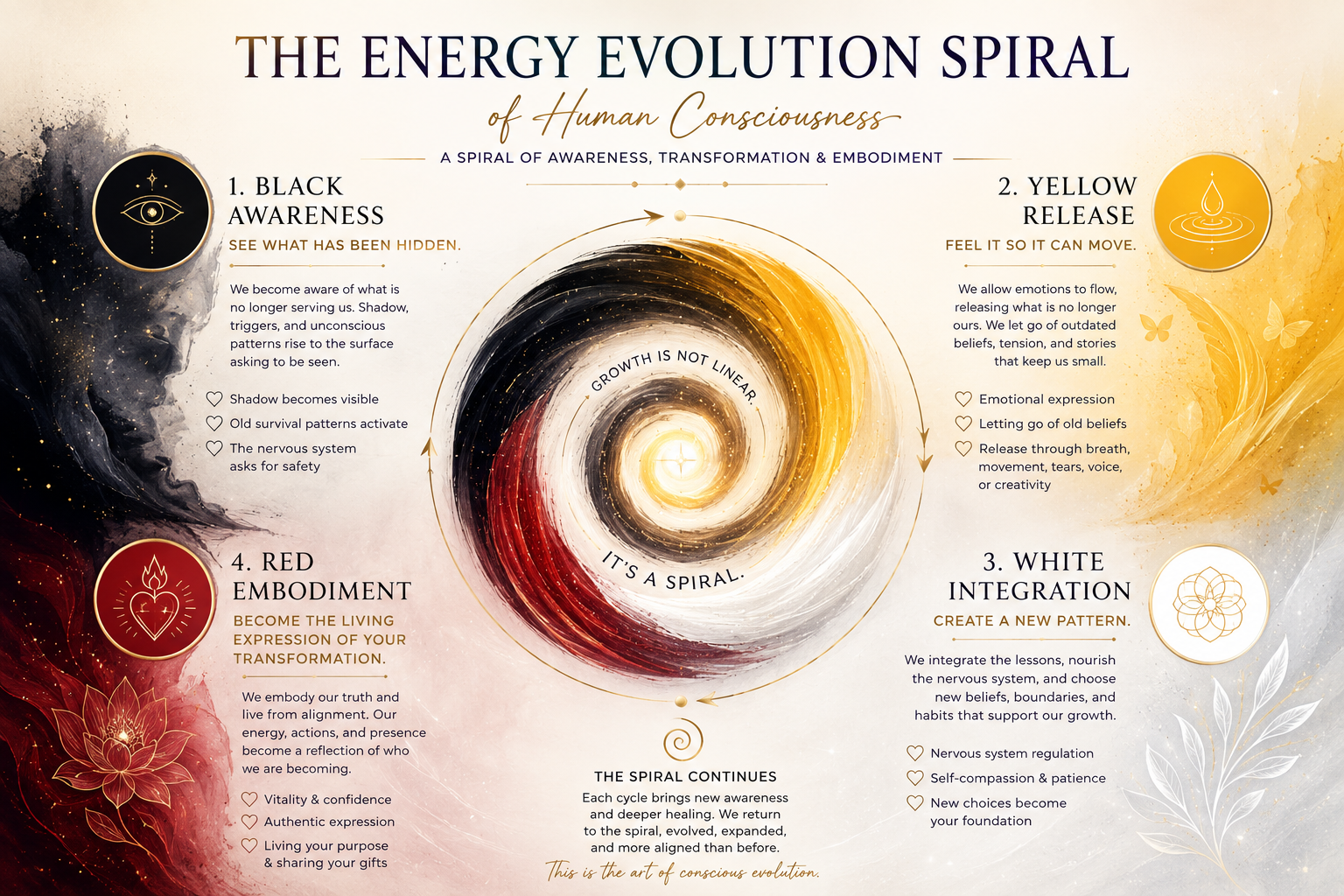
I call this pattern The Energy Evolution Spiral.
Consciousness is Always Moving
Most people believe growth means reaching a destination where life becomes effortless.
In reality, every new chapter introduces new lessons.
A healthy relationship may expose old abandonment wounds.
Starting a business may uncover fears of failure or visibility.
Becoming a parent may awaken parts of your own childhood that were never fully healed.
Each experience offers another opportunity to evolve.
The spiral reminds us that healing isn't about becoming perfect. It's about becoming more conscious each time we move through life's challenges.
Stage One: Black — Awareness
Every transformation begins in darkness.
A difficult conversation.
A breakup.
Burnout.
A loss.
A life transition.
Something disrupts the familiar and brings hidden emotions to the surface.
Although this stage can feel uncomfortable, it serves an important purpose: it reveals what has been operating beneath conscious awareness.
Questions begin to emerge.
Why did this affect me so deeply?
Why do I keep repeating this pattern?
What am I really afraid of?
Awareness is the doorway to change.
Without awareness, patterns continue unconsciously.
With awareness, transformation becomes possible.
Stage Two: Yellow — Release
Once we see the pattern, we can begin releasing it.
Many of us were taught to suppress emotions.
We distract ourselves.
Stay busy.
People-please.
Overwork.
Avoid conflict.
But emotions that aren't processed don't simply disappear. They often remain active in the body and continue influencing our reactions.
The release stage invites us to acknowledge what we're feeling rather than fighting it.
This may include:
Breathwork
Journaling
Somatic movement
Meditation
Honest conversations
Creative expression
Grieving what has been lost
Release is not about forgetting the past.
It is about allowing ourselves to move through it instead of remaining stuck within it.
Stage Three: White — Integration
After something is released, space is created.
This space allows new beliefs, healthier boundaries, and more intentional habits to take root.
Insight alone doesn't create transformation.
Consistent practice does.
Integration asks:
How do I respond differently now?
What boundary honors my well-being?
What habits support the person I want to become?
Little by little, awareness becomes embodiment.
The nervous system learns that safety no longer depends on old survival strategies.
Stage Four: Red — Embodiment
Eventually, growth stops feeling like something we practice and starts becoming who we are.
Our actions begin matching our values.
Our relationships become healthier.
Our decisions become clearer.
We stop reacting from old wounds and begin responding from conscious choice more often.
This is embodiment.
Not perfection.
Not the absence of struggle.
Simply living with greater presence, authenticity, and alignment than before.
Why It's a Spiral Instead of a Circle
A circle returns to exactly where it started.
A spiral returns to familiar themes from a new level of awareness.
You may revisit people-pleasing.
You may encounter another relationship challenge.
You may feel fear before taking your next big step.
But this time, you notice it sooner.
You regulate more quickly.
You recover with greater compassion.
The lesson isn't identical.
You've grown.
The spiral reminds us that every cycle builds upon the one before it.
The Foundation of My Work
The Energy Evolution Spiral is the philosophical foundation beneath all of my work.
The SPARK Method provides a practical pathway for moving through these stages by cultivating awareness, releasing old patterns, activating new ways of living, and sustaining meaningful change.
Awaken Your Inner Goddess applies the same cycle over a longer journey, focusing on emotional healing, self-worth, relationships, embodiment, and purpose.
Whether you're navigating a difficult season, healing childhood wounds, or stepping into a new chapter of life, the process remains remarkably similar.
Become aware.
Release what no longer serves you.
Integrate new ways of living.
Embody the person you're becoming.
Then begin again.
Your Next Evolution
If life feels like it's falling apart, perhaps it isn't.
Perhaps another layer of your authentic self is asking to emerge.
Every challenge contains information.
Every trigger points toward something ready to be understood.
Every ending creates space for a beginning.
The spiral keeps moving.
The question isn't whether you will evolve.
The question is whether you'll move through the next cycle consciously.
Your next evolution may already be underway. Click here take a quiz to see where your energy is headed
Basic Energetic Hygiene for Emotional Regulation
Have you ever walked into a room feeling perfectly fine, only to leave feeling anxious, irritated, overwhelmed, or exhausted?
Have you ever spent time with someone and suddenly felt emotions that seemed to come out of nowhere?
Most people are taught that every emotion they experience originates within them. While that is sometimes true, many people are never taught that humans are constantly exchanging energy with their environment, the people around them, and even the content they consume.
Just as we practice physical hygiene by showering, brushing our teeth, and washing our hands, we can also practice energetic hygiene to help maintain emotional balance and mental clarity.
What Is Energetic Hygiene?
Energetic hygiene is the practice of becoming aware of what influences your emotional state and intentionally clearing, releasing, and regulating your energy throughout the day.
Think of your nervous system as an antenna.
Every conversation, social media post, news story, crowded environment, stressful workplace, and relationship creates an energetic impact. Some people naturally filter these influences well. Others absorb them deeply.
When we fail to clear accumulated stress and emotional residue, it can begin to feel like anxiety, irritability, fatigue, brain fog, emotional overwhelm, or emotional numbness.
Why Emotional Regulation Starts with Awareness
Many people attempt to regulate emotions by suppressing them.
They distract themselves.
They stay busy.
They scroll.
They overthink.
They analyze.
But emotional regulation begins with awareness.
Before asking, "How do I stop feeling this way?" ask:
What am I feeling?
When did this begin?
Is this emotion connected to something in my life?
Did this feeling appear after being around someone or somewhere?
What is my body trying to communicate?
The goal is not to judge your emotions.
The goal is to listen.
A Simple Daily Energetic Hygiene Practice
Step 1: Ground Yourself
Grounding helps bring your awareness back into your body.
Try:
Walking barefoot on grass
Sitting against a tree
Taking slow, conscious breaths
Noticing physical sensations in your body
Ask yourself:
"What am I feeling right now?"
Without trying to change anything.
Just observe.
Step 2: Identify What Is Yours
Not every emotion you experience belongs to you.
When a strong emotion arises, pause and ask:
"Is this connected to something happening in my life right now?"
If the answer is no, you may be picking up on the emotional atmosphere around you.
This doesn't mean the emotion isn't real.
It simply means it may not have originated from you.
Step 3: Release What You No Longer Need
Our bodies are designed to process emotion through movement.
Simple release practices include:
Shaking your arms and legs
Dancing
Stretching
Deep breathing
Journaling
Crying when tears naturally arise
Emotions become problematic when they remain trapped in the body.
Movement helps complete the stress cycle.
Step 4: Protect Your Energy
Protection is not about building walls.
It is about maintaining healthy boundaries.
Ask yourself:
Who leaves me feeling energized?
Who leaves me feeling drained?
What environments support my wellbeing?
What environments consistently overwhelm me?
Reducing unnecessary exposure to draining people, places, and media is one of the most powerful forms of energetic hygiene.
Step 5: Return to Yourself
At the end of each day, take a few moments to reconnect with yourself.
Close your eyes.
Take a few slow breaths.
Ask:
What did I learn today?
What emotions am I carrying?
What am I ready to release?
Imagine any stress, tension, or emotional heaviness leaving your body with each exhale.
Simple practices repeated consistently often create the biggest shifts.
The Missing Piece of Emotional Wellness
Many people spend years trying to fix themselves because they believe something is wrong with them.
In reality, they may simply be carrying far more than they realize.
Learning energetic hygiene doesn't mean ignoring mental health, therapy, or personal responsibility.
It means adding another layer of awareness.
When you learn how to recognize what belongs to you, release what doesn't, and regulate your nervous system consistently, emotional wellbeing becomes less about fighting yourself and more about caring for yourself.
Just as physical hygiene supports physical health, energetic hygiene supports emotional health.
And sometimes, the simplest daily practices create the greatest transformation.
“Where Do I Stand With Him?”
“Where Do I Stand With Him?” Why Power Dynamics Create More Clarity in Dating Than the Vanilla Script Ever Will
Why Power Dynamics Create More Clarity in Dating Than the Vanilla Script Ever Will
You’ve been seeing someone new. The texts are hot, the dates are fun, the chemistry’s there… but underneath it all, that sinking question won’t leave you alone:
“Are we exclusive? Is he actually into me—or just keeping me around?”
If this sounds familiar, you’re not alone. A lack of clarity in communication, roles, and intention is one of the most common frustrations women face in modern dating—especially in the "vanilla" (non-kink) world.
But what if the problem isn’t you...
What if it’s the rules of the game?
The Hidden Problem With Modern Dating Norms
Vanilla dating thrives on ambiguity.
People are told not to be “too much,” not to bring up relationship intentions too early, and definitely not to define dynamics too soon—for fear of scaring someone off.
So instead of honest connection, we end up guessing:
“What are we?”
“Do they like me, or just like the attention?”
“Can I bring up boundaries without sounding needy?”
This constant mental spin creates anxiety, emotional labor, and disempowerment—especially for women who were raised to be agreeable, low-maintenance, or “cool.”
Enter BDSM-Informed Dating: Clarity, Intention & Power
In consensual BDSM and power exchange dynamics, everything is negotiated.
Before play, there’s open discussion about:
What each person wants and doesn’t want
What roles they’re interested in (Dominant, submissive, switch)
What the expectations are around communication, boundaries, and even aftercare
Sound intense? Maybe. But it’s also incredibly freeing.
Because when everyone knows their role and intention, there’s no room for mixed signals or emotional manipulation.
3 Ways D/s-Inspired Dating Creates Relationship Clarity
1. Defined Roles from the Start
In Dominant/submissive dynamics, both people know where they stand.
There’s no confusion about who’s leading, who’s following, or what’s expected—and it’s negotiated, not assumed.
You don’t have to guess if someone wants to take charge, support you, or play games. You ask. And they answer.
2. Communication Is a Non-Negotiable
In kink, safewords and check-ins are standard.
You talk about your limits, your desires, your needs—often before you even meet in person.
This kind of communication builds trust faster than any “just go with the flow” text thread ever could.
3. Contracts and Agreements = Emotional Safety
D/s dynamics often include formal or informal contracts—clear, flexible agreements about what you’re building together.
This isn’t about control—it’s about consent.
You both get to design a relationship (or scene, or dynamic) that actually honors your truths.
And when someone crosses a line? There are consequences—not silence, ghosting, or gaslighting.
The Bottom Line
If you’re tired of wondering where you stand with someone…
If you want your dating life to feel honest, intentional, and hot as hell...
It might be time to explore what conscious power dynamics can offer.
You don’t have to be kinky. You just have to be ready to stop settling for confusion.
Ready to bring clarity, confidence, and desire back into your dating life?
I guide people through dating with polarity, structure, and power—inside and outside the kink world.
🖤 Join the waitlist for my next coaching round, or send me a message to learn more.
What If It Isn't Anxiety?
For more than 20 years, I was told I had generalized anxiety disorder.
Along the way, I collected several other diagnoses as well. I tried medication after medication, hoping the next prescription would finally explain why I felt the way I did.
Some helped temporarily. Many didn't.
What confused me most was that I could rarely identify a trigger.
Everything I learned about anxiety suggested there should be a thought, fear, memory, or situation that activated the response. Yet many times I would feel overwhelming anxiety seemingly out of nowhere.
I remember constantly asking myself:
"Why can't I trace where this is coming from?"
The experience left me feeling broken, disconnected from myself, and convinced something was fundamentally wrong with me.
Over time, my world became smaller.
I struggled to maintain jobs. Social gatherings became exhausting. Crowded environments felt overwhelming. Activities that other people seemed to enjoy often left me depleted and anxious.
The more I tried to manage the symptoms, the less I understood the cause.
Then I began noticing something interesting.
Many of the sensations I called "anxiety" didn't seem to start in my mind at all.
Instead, they started in my body.
I would walk into a room and immediately feel tension, heaviness, irritation, sadness, or nervousness. Sometimes those feelings would disappear the moment I left the environment.
Other times I would spend time with someone who was stressed, angry, or overwhelmed and find myself carrying those emotions for hours afterward.
What if I wasn't generating all of these feelings?
What if I was sensing them?
This question changed everything.
As I began studying energetic awareness, nervous system regulation, somatic practices, and energetic hygiene, I discovered a framework that explained experiences I had never been able to understand through traditional mental health models alone.
Some people are highly sensitive to the emotional and energetic states of others.
They absorb information through their environment.
They pick up on tension before anyone speaks.
They feel shifts in a room before they can logically explain them.
When these sensitivities are not understood, the body can interpret the incoming information as anxiety.
The result is that many people spend years trying to fix themselves when the real issue may be a lack of boundaries, energetic awareness, nervous system regulation, or recovery practices.
To be clear, I am not suggesting that all anxiety is energetic in nature.
Mental health conditions are real, and professional support can be life-changing for many people.
What I am suggesting is that there may be an important piece of the conversation that is often missing.
No therapist, psychiatrist, or doctor ever taught me how to recognize what belonged to me and what didn't.
No one explained emotional absorption.
No one taught me how to clear my energy after being in stressful environments.
No one taught me grounding practices, energetic boundaries, or how to reconnect with my body's own wisdom.
When I finally learned those skills, my life changed dramatically.
The constant overwhelm decreased.
My ability to navigate social environments improved.
I stopped feeling like I was at the mercy of every emotion that entered the room.
Most importantly, I no longer believed I was broken.
Today, energetic hygiene is one of the most important wellness practices in my life.
Just as we shower to clean our bodies, we can learn practices that help clear emotional, mental, and energetic buildup.
These tools are simple, accessible, and often free.
For me, they became one of the missing pieces of the puzzle.
And if you've ever found yourself wondering why your anxiety seems impossible to trace, why crowds drain you, or why your emotions change depending on who you're around, it may be worth asking a different question:
What if your body isn't malfunctioning?
What if it's sensing more than you've been taught to understand?
Why Empaths Attract the Mentally Unstable
How can empaths stop attracting unstable partners?
By developing nervous system boundaries, learning discernment, and choosing emotional stability over intensity.
Lessons Learned and How to Navigate These Relationships
If you identify as an empath, you have probably noticed a pattern.
You do not just attract sensitive people.
You attract people in crisis.
People in chaos.
People who are emotionally unregulated, unhealed, or psychologically unstable.
And often, you become their anchor.
This is not coincidence.
It is a nervous system dynamic.
And until you understand it, it will keep repeating.
The Hidden Magnetism of the Empath
Empaths are not just emotionally perceptive.
They are regulators.
Your presence calms dysregulated nervous systems.
Your listening stabilizes fragmented emotions.
Your intuition anticipates what others need before they ask.
To a person who feels internally unsafe, you feel like home.
Not because you are meant to save them.
But because your nervous system offers something theirs cannot generate on its own.
Calm.
Containment.
Attunement.
This creates an unconscious pull.
Unstable people are not drawn to your kindness.
They are drawn to your regulation.
Why the Dynamic Becomes Dangerous
Here is the part most empaths are never taught.
You do not attract unstable people because you are loving.
You attract them because you tolerate instability.
Many empaths grew up in emotionally unsafe environments.
They learned early how to track moods.
How to de-escalate tension.
How to abandon themselves to keep connection.
So when an unstable person appears, your system recognizes the pattern as familiar.
Familiar does not mean healthy.
Familiar means conditioned.
This is how caretaker dynamics form.
You become the therapist.
The stabilizer.
The emotional container.
And slowly, the relationship stops being mutual.
The Cost to the Empath
Over time, these relationships produce predictable consequences.
Chronic fatigue
Anxiety that does not belong to you
Loss of identity
Hypervigilance
Burnout
Resentment
Confusion about your own needs
You start mistaking emotional labor for love.
And the more you heal them,
the less room there is to heal yourself.
This is not compassion.
This is self-abandonment wearing spiritual clothing.
The Core Lesson Most Empaths Miss
You are not here to heal everyone you can feel.
Sensitivity is not an obligation.
Your gift is discernment, not rescue.
The most important boundary an empath can learn is this:
I can feel you without carrying you.
You are allowed to sense pain and still say no.
You are allowed to love and still walk away.
You are allowed to protect your nervous system.
Because empathy without boundaries becomes self-harm.
How to Navigate These Relationships Differently
This is where real mastery begins.
1. Learn to screen for stability, not chemistry
Intensity is not connection.
Trauma bonding is not intimacy.
Look for emotional regulation, accountability, and consistency.
2. Track your body, not your story
If your chest tightens, your sleep worsens, or your energy drains, listen.
The body detects danger long before the mind does.
3. Stop over-functioning
When you solve, soothe, explain, and rescue, you teach others to under-function.
Healthy relationships are reciprocal, not rehabilitative.
4. Choose partners, not projects
You are not a treatment center.
You are not a crisis unit.
You are a human being who deserves stability.
The Deeper Truth
Empaths do not attract the mentally unstable because they are meant to fix them.
They attract them because this is the final boundary lesson.
To choose yourself without guilt.
To let empathy mature into sovereignty.
To stop confusing suffering with destiny.
When an empath learns discernment, everything changes.
You still feel deeply.
You still love fiercely.
But you no longer sacrifice your nervous system for connection.
And that is when you stop attracting chaos.
Because chaos can only attach to an open wound.
Not to a regulated, sovereign, self-protecting nervous system.
At Collective Healing Temple, we believe sensitivity is a power.
But only when it is paired with boundaries, embodiment, and nervous system wisdom.
Empathy is not your burden.
It is your instrument.
Learn to play it without bleeding.
And your relationships will finally become places of nourishment, not repair.
🔥 Reigniting the Flame: The Spark Reboot Method™
Somewhere between the rush of early romance and the routines of real life, many couples lose their spark. Passion turns to autopilot, connection feels strained, and suddenly love starts to feel like work.
But what if that fading flame isn’t the end of the story—just the invitation to begin again?
That’s the purpose of the Spark Reboot Method™, a four-phase journey designed for couples who have been together for a few years and want to reconnect emotionally, energetically, and physically. It’s not therapy. It’s not a quick fix. It’s a conscious process of rediscovery—for both yourself and your partner.
💫 The Four Phases of the Spark Reboot Method™
The Spark Reboot Method™ was first developed for Shauna and Trent, a couple who deeply loved each other but had fallen into disconnection. Together, we created a pathway that helped them reignite the magic—without forcing it. What they discovered became the foundation of this method.
Phase 1: Self-Reconnection (The Inner Flame)
Before two people can rebuild their relationship, they must first return to themselves.
This phase focuses on individual renewal—clearing the mental and emotional clutter that dims one’s personal light.
Each partner commits to:
Daily rituals of self-devotion and reflection
Emotional release practices to clear resentment and fatigue
Reconnecting to sensual identity, confidence, and purpose
Why it matters: When you restore your own energy, you no longer seek validation from your partner—you share overflow, not emptiness.
Phase 2: Emotional Rebuild (The Bridge Between Hearts)
Once each person reconnects to self, it’s time to rebuild emotional safety and intimacy together.
This phase includes:
Weekly emotional check-ins (listening without defense, speaking without blame)
Acts of curiosity and care to refill the “love bank”
Forgiveness rituals to release unspoken tension
Why it matters: True connection happens when both partners feel safe being seen. This stage rebuilds that bridge, one honest conversation at a time.
Phase 3: Energetic + Physical Reawakening (The Body Connection)
The third phase invites couples to explore presence over performance. Instead of focusing on “fixing the sex,” partners learn how to reawaken attraction through subtle, sacred touch.
They practice:
Breathwork and synchronized movement to reconnect energetically
Sensual—not sexual—touch exercises that awaken body awareness
Guided rituals to honor each other’s boundaries and desires
Why it matters: When the body feels safe again, it becomes a temple for pleasure, not pressure.
Phase 4: Devotional Integration (The Flame Reborn)
This final phase is where everything fuses into something lasting—a love that breathes with intention.
Partners co-create new rituals, vows, and practices that honor their growth, such as:
A shared devotional practice (date nights, energy exchanges, or morning affirmations)
Redefining boundaries, commitments, and shared dreams
A symbolic “spark ceremony” to mark their rebirth as a couple
Why it matters: The Spark Reboot Method™ doesn’t just reignite passion—it evolves it. The goal isn’t to return to who you were, but to consciously create who you’ll become, together.
🌹 The Heart of the Spark Reboot
Every relationship has seasons. Some bloom effortlessly. Others require tending, pruning, and light.
The Spark Reboot Method™ helps couples move from autopilot to awareness, from comfort to curiosity, from surviving to soulfully thriving.
Because the truth is—love doesn’t fade. It just waits for you to remember how to feed it.
From default to devotion: Why most women are starving in plain sight
The Conscious Courtship Method™ is a heart-centered approach to love and relationships that blends emotional intelligence, energy awareness, and feminine leadership.
It teaches women how to attract and build relationships that align with their worth—not their wounds. Through guided reflection, archetype work, and energetic mastery, you’ll learn to lead in love with softness, integrity, and confidence.
By Angela, Energy Healer & Founder of The Collective Healing Temple
Let’s get something straight:
Most women aren’t lacking love. They’re lacking leadership—of their own lives, their relationships, and their desires.
They’re starving for depth while pretending crumbs are enough. They’re doing everything right in the world’s eyes… and still feeling unseen, untouched, and unfulfilled.
And it’s not their fault. We were trained to tolerate the bare minimum. Trained to keep the peace, to shrink, to serve.
Trained to be agreeable instead of adored.
But here’s what I teach inside The Collective:
You don’t need another tip, app, or script.
You need a transformation—from default to devotion.
What Is Default Mode?
Default mode is autopilot. It’s how most women operate in relationships, even the high-functioning ones.
It’s:
Saying “I’m fine” when you’re not.
Letting your partner lead because you’re tired of explaining yourself.
Suppressing your sensuality because it’s never been fully welcomed.
Accepting love that’s technically “nice,” but never devotional.
Default mode is safe—but it’s not sovereign.
What Devotion Feels Like
Devotion is a relationship built on reverence.
Where your voice isn’t tolerated—it’s worshipped.
Where your standards aren’t “too much”—they’re the blueprint.
Devotion is structure. Sensuality. Power. It’s a partner who listens to your leadership and rises to meet it. Most importantly—it starts with YOU. Devotion begins when you stop abandoning yourself.
Why I Created the Conscious Courtship Method™
No, it’s not about rules, roles, or playing games. Conscious Courtship is about helping women lead in love without losing softness, integrity, or intimacy.
It’s the art of dating and relating with awareness—learning to connect, communicate, and co-create relationships that serve your soul, not your patterns.
It’s about reclaiming:
✨ Structure without rigidity
✨ Sensuality without shame
✨ Power without apology
Inside The Collective, I guide women through each phase of Conscious Courtship— from understanding their core archetype, to recognizing emotional patterns, to designing relationships that reflect their values and vision. This isn’t about controlling others—it’s about mastering your own energy, your standards, and your self-worth.
Ask yourself:
💭 Are you tired of shrinking to make others comfortable?
💭 Are you curious what it would feel like to be cherished, not just chosen?
💭 Are you ready to stop dating from your wounds and start leading from your wisdom?
If so, you’re not just ready for a better relationship—
you’re ready for a more conscious one.
Your Invitation
If your body said yes while reading this—don’t ignore her.
The Collective is where we walk this path together.
Because you weren’t made to settle. You were made to lead with devotion.
Let’s begin.
🖤
Lady A
Conscious Courtship for the Woman Who Refuses to Settle
Rediscover Your Desires. Reclaim Your Power. Redefine Relationship.
Tired of Swipe Culture and Surface-Level Situationships?
If you’ve ever found yourself asking, “Is this really all modern dating has to offer?”—you’re not alone. Today’s dating landscape is saturated with ghosting, breadcrumbing, poly-paranoia, and “let’s keep it casual” energy. But here’s the truth:
You were never meant to settle for less than intimacy that ignites you.
Welcome to conscious courtship—a reclamation of romantic power, where you lead with desire, self-devotion, and conscious choice.
What is Conscious Courtship?
It isn’t about playing the game better. It’s about throwing the old rulebook out altogether.
It’s a dating paradigm rooted in:
Radical self-awareness
Clarity of desire
Alternative relationship styles
Embodied communication
Whether you're curious about ethical non-monogamy, female-led relationships, conscious kink, or simply want a deeper sense of connection, Conscious Courtship asks:
👉 What would it look like to date from erotic truth instead of emotional survival?
🔥 5 Pillars for Empowered Women
1. Clarity Over Chemistry
Modern chemistry can be trauma-bonding in disguise. Conscious Courtship invites you to pause and ask:
What type of relationship dynamic actually nourishes you?
Do you crave leadership, devotion, freedom, submission, or polarity?
2. Alternative Relationship Styles
Conscious Courtship means exploring what actually fits—not what’s expected.
🔹 Ethical Non-Monogamy
🔹 Female-Led Relationships (FLR)
🔹 Kink-Based Courtship
🔹 Intentional Celibacy or Devotional Partnerships
Gone are the days of settling into heteronormative scripts that don’t serve your soul. The goal is alignment, not approval.
3. Devotional Self-Dating
Before you devote yourself to another, you must learn the art of self-devotion.
New age women are reclaiming solo time as sacred. Think:
Solo intimacy practices
Journaling your erotic truth
Taking yourself on dates that reflect how you want to be treated
4. Conscious Vetting & Boundaried Courtship
No more “going with the flow” when the flow is headed for a crash.
Conscious Courtship involves:
Creating a vetted initiation process for anyone who wants access to your time or body
Speaking boundaries early—with clarity and confidence
Using archetypal dynamics to help understand relational polarity (Are you a nurturer? A brat tamer? A Queen?)
This isn’t about power games—it’s about embodied sovereignty.
5. Emotional & Erotic Intelligence
Your body holds the wisdom your brain was trained to suppress.
Whether you're dominant, submissive, or just done with disconnect, building emotional and erotic fluency allows you to:
Communicate what you want clearly
Receive without guilt
Play, surrender, or lead with conscious presence
Inside Awaken Your Inner Goddess, this is where things get juicy—because we’re not here to fake confidence. We help you become the woman whose presence is unforgettable.
Don’t know where to start? Click here for the transformation Doorway